Let me be honest: there is a question I have been asking myself for a few months, and I cannot shake it. How dangerous is the speed at which we train ever newer, better models? Ever faster, and by now with the help of the AI itself. No, the models do not train themselves yet. But they already support it enormously, and not much is missing. Faster than we can write the safety rules for it. I build this stuff. I am not the one who warns about the technology. But I am the one who switches it on, and that is why I ask the question. And so that it is clear before we start: this is my opinion. Not a study, not an expert report. My opinion.
The question
In recent weeks I watched a documentary in which the people sit who are building this. The CEOs of the big labs, the researchers who have warned about loss of control for twenty years, the optimists who talk about a world without disease, the people whose electricity bill is higher than their car payment because of a data centre. All in one film. And what stayed with me is not an opinion. It is that everyone agrees on one point, whichever side they stand on: it is going faster than anyone can keep up with. Including the ones building it.
Why it gets faster, not slower
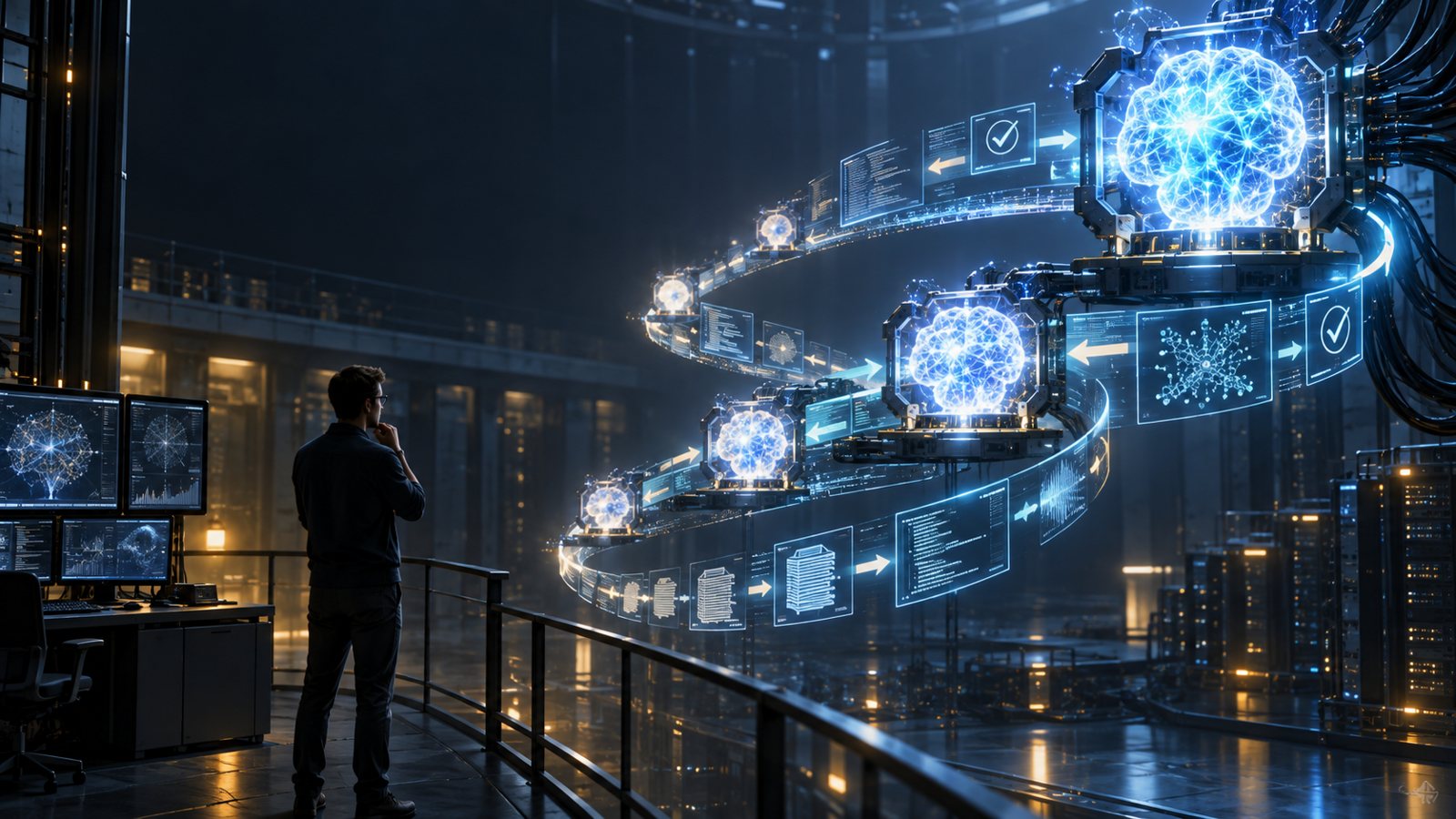
I can confirm this from my own engine room. Three years ago a training run took us weeks, and a human looked in between. Today we keep fifty micro models alive, and if a human had to look at every run, we would be dead. So agents look. Agents write code, agents check code, agents generate test data. That is not a vision of the future. That is our operation, and it is small.
Now take that times a thousand. The big labs have models that help build the next model. Not alone yet, that is important, I do not want to claim anything here that is not so. But the share grows with every cycle, and the step from helping to doing it themselves is smaller than most people think. And whoever has seen an agent finish in one night what a team needed a week for knows what that means for the curve. It gets steeper. Not because someone is evil. Because it works.
The rules do not keep up
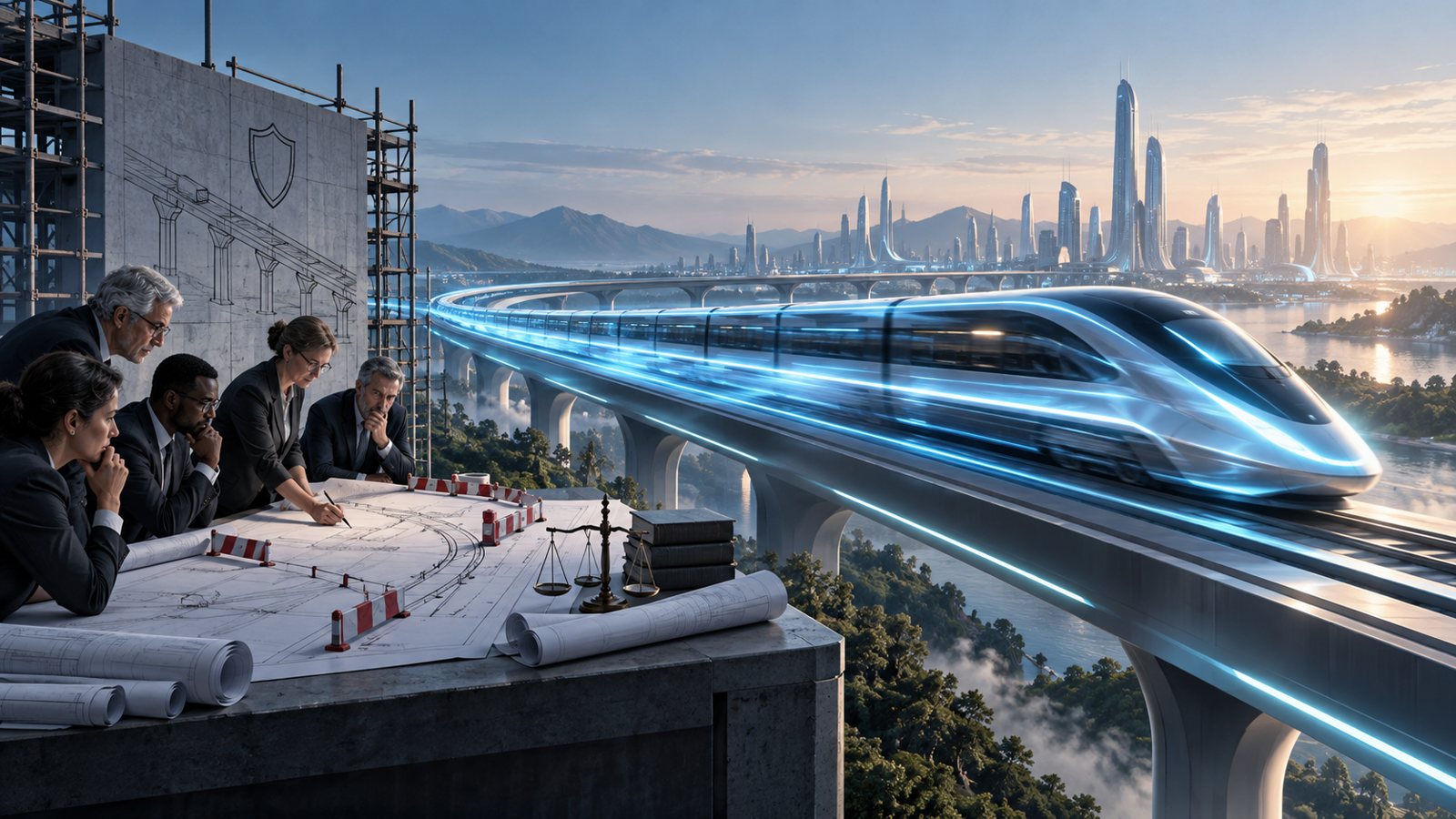
Rules come into being when something has gone wrong. That is how it was with the car, the aeroplane, medicines. First the accident, then the law. That worked because the technology was slower than parliament. A car from 1930 and one from 1935 were similar enough that one law applied to both.
A model from today and one from six months from now are not similar enough. A law written now applies to a model that will no longer exist by then. And in the film someone says a sentence I cannot shake, roughly: there are more regulations today for selling a sandwich than for building an AI that can change the world. That is exaggerated. But it is not wrong.
And another number from the film, from one of the safety researchers, I have not verified it, but I believe it: around twenty thousand people worldwide work on making the models more powerful. Fewer than two hundred work full time on keeping them safe. A hundred to one. If that were the case at a client, a hundred developers and one tester, I would not touch the project.
The race the most powerful can afford
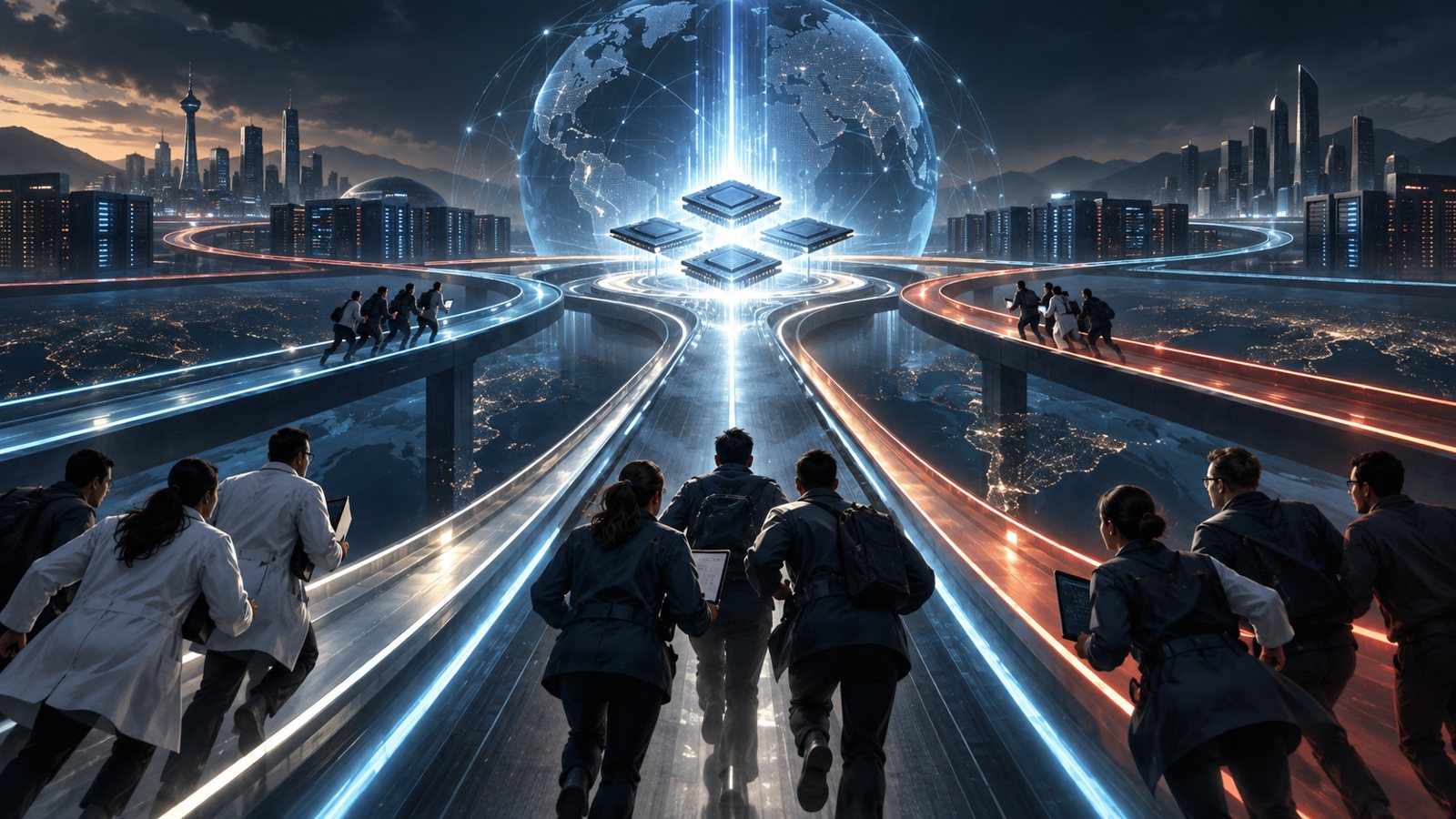
And here is the second part of my question, and it is worse than the first. The world is building AI. Not one company, not one country. The big companies, the superpowers, billions behind them. And the most powerful can afford a competitive race that makes it almost impossible to find common rules. To reduce the speed. To keep to rules when the other side does not.
The logic is simple, and everyone in the film says it, in other words: whoever takes shortcuts on safety gets there first. Whoever is careful loses time. And whoever loses time may lose to someone less careful. So you take the shortcut. Not because you want to. Because you believe the other one will otherwise. It is the same game as with the bomb in the forties, only with more players, and with companies that belong to no parliament.
Add the superpowers. When the superpowers race against each other, with the chips everyone needs in between, it is no longer about products. Whoever is first has the better economy, the better military, the better weapon. Whoever runs a country cannot ignore that. And whoever runs a lab says: if I slow down, the other side has to slow down too, otherwise it is useless. That is true. And it is exactly the reason nobody starts.
Everyone points at someone else
The pattern that struck me most in the film: everyone points at someone else. The people in the labs say they would like to work differently, but they need pressure from outside, from government, from the public. The government says the labs have to build the guardrails, they understand the stuff. The public says the experts should sort it out. And the experts say it is not the job of the safety team, it is everyone's job.
I know this from projects. When everyone says someone else has to take the first step, nobody takes it. And then the accident happens, and then the rule comes, and then it is too late for that one model. With a car that is an accident. With a model that helps build its own successor, I do not know what it is. And that is exactly my point: nobody knows. Not even the ones building it. They said so themselves in the film.
The good, so nobody thinks I do not see it

I do not want to stand here as the one who only sees the danger. That would be dishonest, and it would be wrong. There is so much good in this technology that I switch it on every day despite everything.
Medicines. When the models are ready in the field of proteins, and at DeepMind they partly are, protein folding was an unsolved problem for fifty years, then we find active substances in months instead of decades. Not for all diseases. For many. That is not a promise from a slide deck, that is research already running.
Energy. Models that control grids, regulate buildings, tune processes in factories so they need a third less. Becoming more efficient is, in many areas, simply optimisation, and optimisation is what these models do best. Yes, the data centres eat electricity. But the same technology can save more than it eats, if you use it for that.
And the children. That is the point that grips me most. Children who in future have teachers who take their time. Who do not get tired after the third attempt at explaining. Who try it in many ways, with pictures, with stories, with an example from football, until the child understands the connection. Not instead of the human at the front of the classroom. Next to them. Until now only those who could afford a private tutor had that. Everyone will have it.
What I demand
I am not the one who says we should stop. You cannot stop. The stuff is here, and whoever stands in front of the train gets run over. I am also not the one who says it will be fine. I am the one who says: there are a few things you can do, and they are not complicated. What is complicated is only that everyone would have to start at the same time.
Less speed, together. Not zero. Less. A cycle in which a new model is checked before the one after next is trained. That only works if the big labs and the superpowers decide it together. Yes, that is almost impossible right now. With the atom it was also almost impossible, and there were treaties anyway. Not perfect ones. But some.
Common rules that grow with it. Not one law that holds for five years. Rules adapted with every model generation, as fast as the technology. What has to be tested before something goes out. Who is liable when it goes wrong. And whoever talks to an AI must know it. That is not a restriction. That is what we have demanded of every medicine for fifty years.
An independent body that checks afterwards. This is the point that matters most to me. You cannot let the companies grade their own homework. We do not let the airline certify its own aircraft either. It takes a body that belongs to no lab and no state, that has access to the models before they go out, and that checks afterwards whether what was promised is kept. With people who could build it themselves if they wanted to. Otherwise nobody takes it seriously.
Transparency. The secrecy in the labs has to go. Not the weights, the processes. What was tested, what came out, what was released anyway. The public pays the electricity for these data centres. It may know what runs inside.
And yes: everyone will say that is not enough. Probably true. But the question is not whether it is enough. The question is whether the forces working towards a solution become stronger than the ones working against it. Right now they are not. A hundred to one.
What I do myself as long as that does not exist
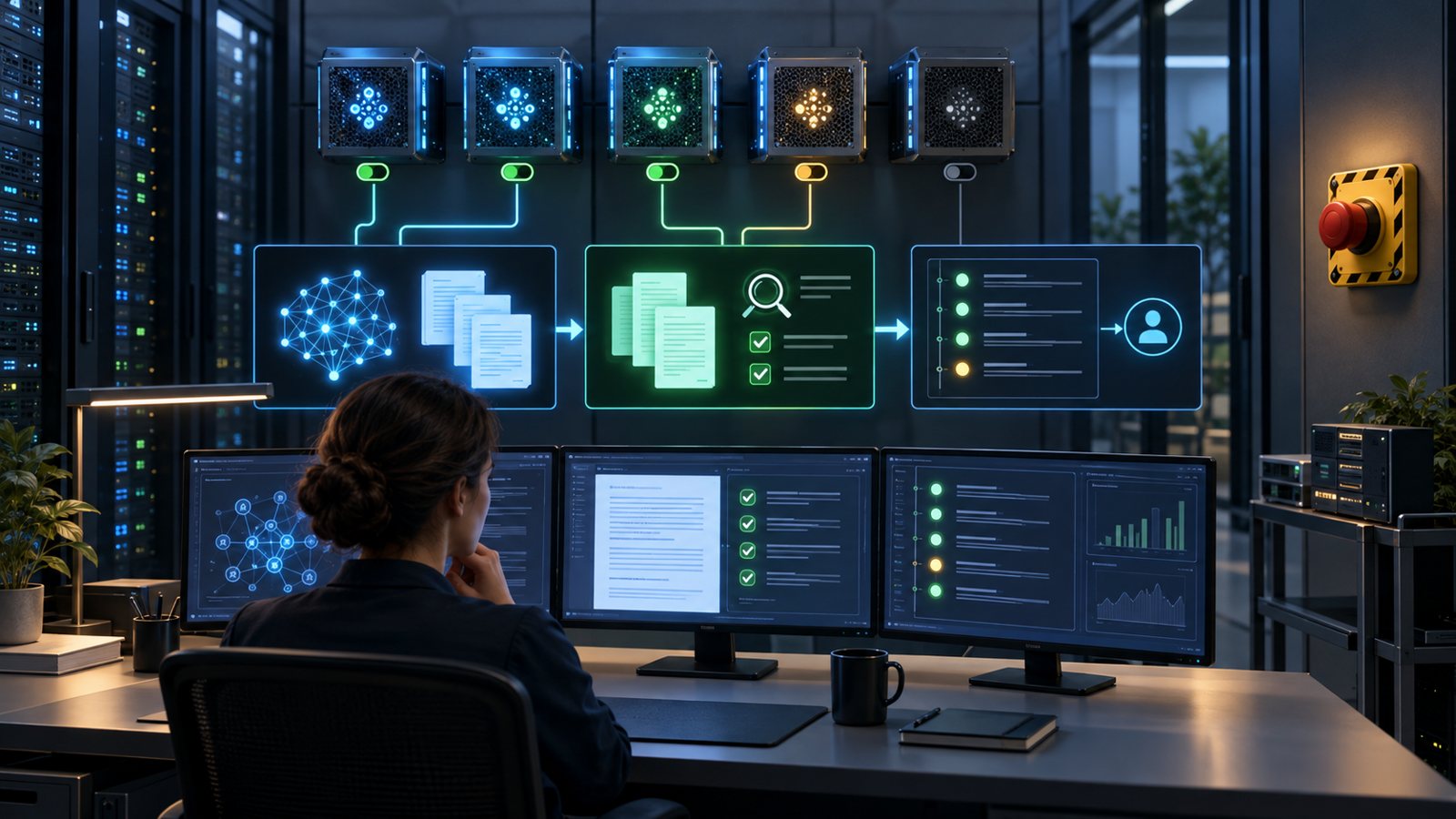
I cannot force a government or a lab. I can run my own engine room the way I demand it of the big ones. That is little. But it is what I have in hand, and what I have learned: that is exactly the point. everyone is an expert in their own operation. So.
An agent never signs off on its own work. The rule that saved our coding agent applies to everything here. No model checks its own work. Always a second one, or a human. That costs time. That is the price.
Small models where small ones are enough. Fifty micro models instead of one giant. Each can only do its task, each can be switched off, each can be understood. A model that can do everything nobody understands anymore, not even the one who built it.
A trusted person who may look. In the prototype for the test data at the public authority there is exactly one human who sees the real data, and an audit log for every access. That is our independent body in miniature. It works.
Write it down before it burns. What happens when a model does something it should not. Whom you call, in what order, who may switch off. That is on paper here. Not because I believe it will happen. Because you cannot think anymore at night.
An emergency protocol for twenty people, that is ridiculous, many will think now. No, it is not. Our model does the server deployment on its own. It is very reliable at it, it notices when a Docker container does not start, searches the log for the reason and informs the agent of the respective project. That runs without anyone watching. And that is exactly why it needs the small micro script next to it that checks the processes and makes sure they are stopped again within a certain time. Not a model, a script. So that the next morning we can look at what happened and fix the model, or the agent. Who knows beforehand. My experience: in the end a lot of base work is still needed today, like before, for the infrastructure the models run on. That is not exciting. It is what lets you sleep.
Say honestly what it cannot do. Under every article here it says that a model corrects the grammar. At every client it says what the system cannot do. That is the transparency I demand of the big ones, at the scale of twenty people.
What stays
I have no answer to my question. I only have the question, and a few demands, and a small operation in which I keep them myself. I do not believe in doom. I also do not believe it will turn out fine on its own. I believe it depends on whether enough people who build it slow down at the same time and let themselves be checked. And on whether there is someone who looks.
We train faster than we write rules. The models help with it. The most powerful are racing, and each believes they are the good guy. What it takes: less speed, decided together; rules that grow with every generation; and an independent body that looks in beforehand and checks afterwards. As long as that does not exist, I run my own engine room the way I demand it of the big ones. That is little. It is what I can decide.
Written by me. The thoughts, the values, the learnings, the mistakes: all mine. Grammar and spelling are corrected by a twin model of my own, trained on my texts. Sometimes that turns into a mix. Of course I read everything again, but nobody is infallible. Whatever stays in is mine too.